
Bahrain Constitutional History Since Independence

Bahrain Constitutional History Since Independence

Bahrain Constitutional History Since Independence

quote
divider_hori

The constitution was promulgated in December 1973, concurrent with the election of the members of the National Assembly, thereby transforming the country into a constitutional monarchy.

divider_hori

Shortly after independence was declared in 1971, the Emir, Sheik Khalifa bin Salman Al Khalifa, in 1973 issued a decree creating a Constituent Assembly to draw up a new constitution, thereby transforming the country into a constitutional monarchy.

The Constituent Assembly was to be composed of 22 members popularly elected, plus 8 members appointed by the Emir, and 12 members of the Council of Ministers (also appointed by the Emir), for a total of 42 members. The Constituent Assembly drafted a constitution providing for a unicameral National Assembly, composed of 33 members popularly elected, plus 14 ministers appointed by the emir. The constitution was promulgated in December 1973, concurrent with the election of the members of the National Assembly, thereby transforming the country into a constitutional monarchy.

loading the player....

Only this one election was held under the new constitution. In 1975, the constitution was suspended because the National Assembly refused to adopt the State Security Law of 1974. A “state of emergency” was declared, and Bahrain was ruled for the next two decades by royal decrees carried out by appointed ministers.Bahrain Parliament
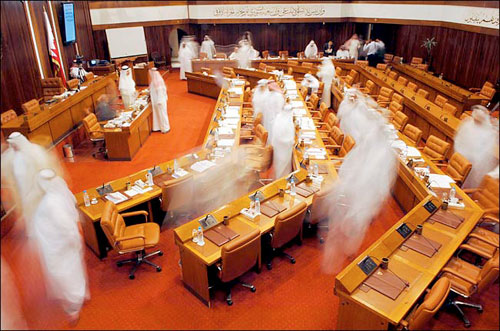
Upon the death of Emir Khalifa bin Salman Al Khalifa in 1999, his son, Hamad ibn Isa Al Khalifa, becomes Emir. In 2000, the new Emir issued a National Action Charter (NAC), proposing to return to constitutional government, but also proposing to amend the 1973 constitution by providing for a bicameral parliament, consisting of a popularly elected lower chamber of 40 members with legislative powers, and an upper chamber of 40 members to be appointed, but having only advisory powers.

The new constitution was adopted by referendum on February 14/15 2001, with 94% of votes cast. On February 17, 2001, the Emir declared Bahrain to be a Kingdom.

In 2002 the King promulgated the new constitution, but made changes it to make the upper, all appointed by the King, equal in legislative power to the elected chamber. Elections were called for October 24/30, 2002, but many parties of both the secular left and religious right (Shi’a) boycotted the elections to protest the change in the powers of the upper chamber. Sunni Islamists win at least 18 of the 40 seats in the lower chamber, while secularists win 21.

In the parliamentary elections of 2006, with no boycott and a turnout of 72%, Shi’a and Sunni Islamists won a majority of the seats, with secular liberals reduced to a minority.

In the 2010 elections, Shi’a Islamists win 18 seats, with Sunni Islamists, Sunni Salafists, and Sunni Independents winning 22.

Bahrain constitutional history, Bahrain history, Bahrain independence, constitutional monarchy in Bahrain, government of Bahrain, history of Bahrain, parliament Bahrain, parliament of Bahrain, policies of Bahrain, politics of Bahrain
Related Articles
Bahrain's History: Making of the Constitutional Monarchy Bahrain's History: Making of the Constitutional Monarchy ... - ( 13-09-2011 09:47:33)
Bahrain Top Stories Bahrain's History: Making of the Constitutional Monarchy In 1970, Bahrainis voted overwhelmingly to become an independent ...
Why There Were Protests and Riots in Bahrain?Why There Were Protests and Riots in Bahrain?... - ( 05-07-2011 09:29:06)
Bahrain Videos Video Interview with Abdulrahman A.Hussain Jawahery, President of Gulf Petrochemical Industries Co. (GPIC) and Member of Parliam...
Bahrain Stablity: Parliament's role in Bahrain's ProgressBahrain Stablity: Parliament's role in Bahrain's Progress... - ( 05-07-2011 08:58:57)
Bahrain Videos Video Interview with Abdulrahman A.Hussain Jawahery, President of Gulf Petrochemical Industries Co. (GPIC) and Member of Parliam...
 
[Back]

Add comment

Banner


Related Items
 
 
Top Interviews
Dr. Hassan A. Fakhro, Bahrain Minister of Industry & Trade Bahrain Ministry of Industry: Economic & Industrial Development of Bahrain

Dr. Hassan A. Fakhro, Bahrain Minister of Industry & Trade

How much easier it is to be critical than correct (Disaeli). I would ask those who would criticize Bahrain, to look to their own countries

Bahrain National Oil and Gas Authority Outlines Future of Bahrain Oil and Gas Industry

National Oil and Gas Authority, HE Abdul Hussain bin Ali Mirza, Bahrain Minister of Oil and Gas

Today, the income from oil and gas constitutes about 80% of the government's revenue. However, we were also the first GCC country to attempt diversification, in the 1960s and 70s. Thanks to those efforts, oil and gas now only constitute 24% of GDP at current prices (and 12% at constant prices).

Peter Kaliaropoulos, CEO of Bahrain Telecommunications Company (Batelco) Batelco Bahrain: Leading Telecom in the Middle East

Peter Kaliaropoulos, CEO of Bahrain Telecommunications Company (Batelco) - Biography

Key challenge remains overall industry growth in terms of gross revenue and number of services since we have experienced price erosion due to entry of new companies.

Bahrain Government: Reforms, Stability and Economic Growth

HE. Shaikh Fawaz bin Mohammed Al Khalifa, President of the IAA

The Bahrain Government intends to carry on its steady reform for the country. 

Abdulrahman A.Hussain Jawahery, President of Gulf Petrochemical Industries Co. (GPIC) and Member of Parliament GPIC: Role of Bahrain's Fertilizers in World's Food Security

Abdulrahman A.Hussain Jawahery, President of Gulf Petrochemical Industries Co. (GPIC) and Member of Parliament - Biography

AG fertilizer producers are expected to continue to play a strategic role in meeting this challenge by contributing towards international efforts to increase food production by substantially increasing their share of exports.

Bahrain Masterplan: Affordable Housing in Bahrain is the Highest Priority

Aaref Hejres, CEO of Diyar Al Muharraq

Another reason why we think this year is good is that we have just finished our first landsite in Diyar and sold land worth $260 million to a private developer who will build affordable housing.

Omar Al Mardi, Managing Director, Bahrain Financial Harbour Bahrain Financial Harbour: Business Location in the Middle East

Omar Al Mardi, Managing Director, Bahrain Financial Harbour

There is also a higher local demand in Bahrain that differs to other Gulf countries. Because our population density is very high- with 600-700 people per square kilometer, the local demand is enough to push the construction market.