
Exploring East Amman
Many people visiting the country are warned that the Eastern areas contain nothing that might interest a foreigner, or worse, that these areas are dangerous. This is truly unfortunate; visitors to Jordan and residents of other areas are missing out on an important part of the Jordanian experience by not exploring East Amman.
Exploring East Amman
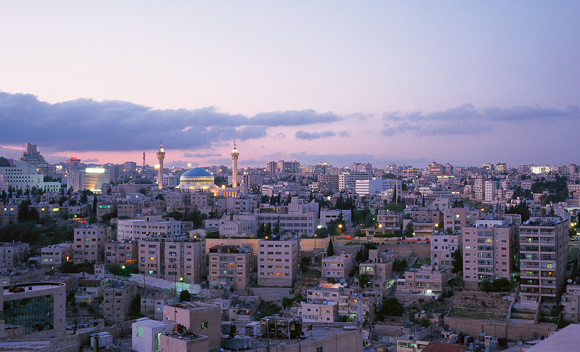
As the capital city of Amman, Jordan has grown and expanded, there has been a shift in the terms used to label the different parts of the city, giving rise to a sense of division in the different regions’ identities. The mountains that make up the Eastern part of the city, and which had always just been “Amman,” are now termed “East Amman,” while the newer neighborhoods and developments that spread west of the original city  came to be known as “West Amman.” While West Amman is characterized by a unique, cosmopolitan feel and a multitude of tourist attractions, the mountains of East Amman are not usually a target for visitors that come to Jordan.
Many people visiting the country are warned that the Eastern areas contain nothing that might interest a foreigner, or worse, that these areas are dangerous. The consequence is that very few tourists or even local residents from other parts of the city venture into neighborhoods such as Al-Taj, Al-Ashrafiyah, Al-Nasr, Al-Hashmi, or Al-Akhdar. This is truly unfortunate; visitors to Jordan and residents of other areas are missing out on an important part of the Jordanian experience by not exploring East Amman.
The population of East Amman makes up a significant segment of Jordanian society. The mountains of East Amman were the first parts of the city to be inhabited and developed; because they are older, they are now also on average poorer than the newer neighborhoods of West Amman, as many inhabitants who had money to invest and build with moved westward into new developments.
Spice sellers and bakeries serving fresh bread dot the neighborhoods, and families send their children out each morning to buy the daily breakfast of hummus and falafel from small take-out restaurants.
East Amman is known to be a socially and economically diverse section of the city, as it is home to some of the oldest communities of Amman, such as the Armenians and Circassians. Communities like these, with their churches, mosques, and community schools have given an eclectic flavor to the social makeup of the city for decades.
More recently, the availability of lower rent housing in East Amman has been an important factor in attracting foreign residents to these neighborhoods, such as immigrant workers from countries like Egypt, and political refugees from other neighboring countries. In East Amman, people of different economic status coexist in the same neighborhoods: large, extravagant villas and low-end apartment buildings stand side-by-side throughout these areas.
Part of the pull of the culture and lifestyle in East Amman is the strong Middle Eastern identity these areas have been able to maintain, even with the influx of heavy Western influence from media and foreign investment. Unlike West Amman, where American fast food chains, one-stop mega-stores, and shopping malls full of international designer brands are widespread, East Amman has held on to a more “authentically Middle Eastern” way of life, at the center of which lies the family. Families purchase their groceries from small corner stores, local butchers, and produce vendors that can be found on every street. 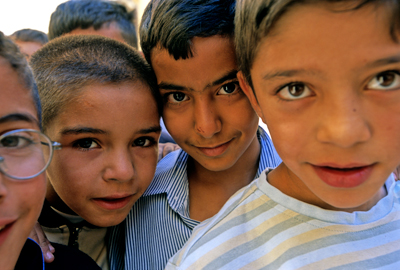
Spice sellers and bakeries serving fresh bread dot the neighborhoods, and families send their children out each morning to buy the daily breakfast of hummus and falafel from small take-out restaurants. Larger shopping areas and markets such as those in Hayy Nazzal or the Wahdat refugee camp, located to the south east of the mountains, serve as major go-to places for clothing, furniture, and household item, as well as medical needs.
Many families in East Amman do not own cars, and residents walk a lot or rely heavily on public transportation such as buses and shared taxis, called ‘serveese’s. The sharing of public space allows for a lot of interpersonal interaction, as well as a sense of communalism. Additionally, the proximity of most of the houses in these areas further encourages a more interactive environment for residents than most neighborhoods of West Amman do: neighbors call out greetings to each other from their porches, crowds of children walking to and from school fill the streets, and young men relax with friends on the street corners, enjoying the public space. The pace of life seems less rushed than in the Western parts of the city.
Less affluence in East Amman does not equal crime. A sense of community and safety pervades the neighborhoods. Concepts such as shame and propriety, which have always been very important notions in the cultures of the region, continue to heavily influence people’s behavior in these areas. For example, elders in the community watch out for the youth because it is the “proper” thing to do, and men who harass women are publicly frowned upon for behaving “shamefully.” The communities are often so tightly-knit and rooted in trust that many residents, for example, have unofficial accounts with their local corner shops: 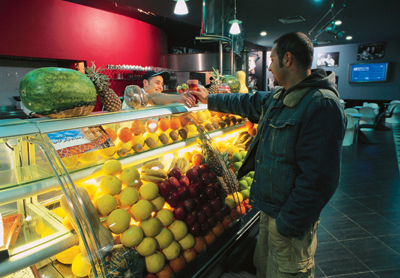
the shopkeeper records a customer’s purchases then sends them a monthly invoice, a process which has been passed down from generation to generation. The structure of life in East Amman and a desire by its inhabitants to uphold their traditional customs result in a real sense of community and safety for the residents; families know one another and people can be sure that neighbors are there to look out for each other.
The medley of people from different ethnic, religious, social, and economic backgrounds that makes up the population of East Amman, as well as the unique identity of the area and its residents give East Amman a distinct feeling of diversity and a strong sense of community. People who make their homes in neighborhoods of East Amman express surprise to learn that visitors are sometimes warned away from what they know to be a warm, welcoming home.
Those who are interested in experiencing a hospitality-centered, community-based way of life that is more reminiscent of traditional Middle Eastern societies will find a visit to East Amman rewarding. It is crucial that anyone wanting a balanced view of Jordan and its people explore these neighborhoods.