
Jordan Banking Sector
Despite the minor drop in ratings, the Banking sector in Jordan is healthy and enjoys an increasingly sound operating environment. The top players are Arab Bank, Housing Bank for Trade and Finance and Jordan Islamic Bank.

Banking Sector
Content
The general outlook on the Jordan economy after the world financial crisis hit in 2009, according to to Simona Sabella, General Manager of Arab Banking Corporation, “Jordan is not different from the rest of the world but it’s much  better than what we’ve seen in Europe and everywhere else.”
Since 2000, Jordan’s economy had been growing at a healthy rate of 6%-7% a year, reaching 8% in 2004, and 7.8% in 2008. The world financial crisis caused a drop in exports, construction, real estate prices, and some major developments to be delayed, resulting slower growth, but it did not stop growing.
Growth in 2009 was 2.8%, and is expected to rise to 3.5% in 2010.
Unlike many other countries in the world, Jordan’s banking sector came through virtually untouched. Mazen Tantash, Chairman of Tantash Group, feels that the crisis proved the fundamentals of the economy to be good shape:
“I think every country in the world has experienced the negative impact of the global financial crisis. In Jordan, FDIs and exports [went] down in 2009 and the budget deficit has widened. [But]I don’t think Jordan has suffered as severely as other countries in the region or in the world.
H
aethum Buttikhi
, Jordan-Kuwait Bank
The banking sector in Jordan is very strong and successful
I think we have one of the most solid and sound banking sectors in the region…the fundamentals of the banking sector will give our economy a solid base when we need to move forward in a better, normal economic situation.”
Haethum Buttikhi of Jordan-Kuwait Bank agrees: “The banking sector in Jordan is very strong and successful….The sector is mature, well-established and well-regulated. It also has the manpower to work in the institutions. There are roughly 15,000 bankers in Jordan and the vast majority are Jordanian staff. During the crisis, not a single bank had any losses.
The banks came out very well capitalized, with healthy non-performing loans, and…excellent standards above the requirements of Basal II…Our Central Bank has also helped the banking sector to weather the storm and protected them from exposure that could have really affected them negatively. There are very few weaknesses in the sector.”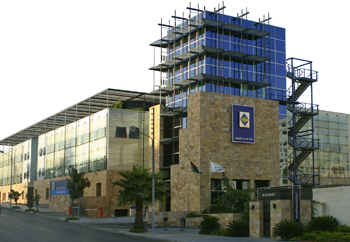
Arab Bank
According to Abdel Hamid Shoman, Chairman of Arab Bank, “Despite the minor drop in ratings, the Banking sector in Jordan is healthy…[and] enjoys an increasingly sound operating environment…. The country has succeeded in developing and applying sound monetary tools and regulatory policies.”
Arab Bank is the largest financial institution in Jordan in terms of both assets market capitalization. It was the first public shareholding company to be listed on the ASE in 1978.
“What is important to mention, Says Shoman, “is that we are a regional player and we have had presence in some Middle Eastern countries before they even had a central bank.
We also have the world’s largest Arab banking branch network with over 500 branches in 30 countries across five continents. Our network and successful history gives us an edge over other banks….In terms of growth strategy, we have mostly relied on organic growth.”
Islamic Banking
Islamic banking is becoming an important alternative to ordinary banking in Jordan. Jordan Islamic Bank (JIB) was the first to open in 1978, followed by Arab International Islamic Bank in 1998. By 2008, these constituted 11% of the 23 banks in Jordan, but 12.5% of deposits, and 15% of total bank credit. In that year, however, Islamic banking began growing even more, with the entry of Dubai Islamic Bank and Jordan Dubai Islamic Bank. In 2010, Saudi Arabia’s Al Rajhi Bank is joining them.
Musa Shihadeh
, General Manager of
Jordan Islamic Bank
(JIB)
we operate by financing the commodity…. People like our system because we do not pay or charge interest.
In many respects, Islamic banking seems to offer a much more considerate and human touch to banking than traditional banks. According to Musa Shihadeh, General Manager of Jordan Islamic Bank (JIB),
“People open accounts with us based on trust. We operate according to Islamic Law, and invest the customers’ deposits over the course of one year. At the end of the year, we give them how much they earned on their investment, deducting about 10% from the profit as a fee for managing the portfolio.”
Our principle, he says is: no interest; “we operate by financing the commodity…. People like our system because we do not pay or charge interest.”
People also like the way JIB’s considerateness: “in the Islamic finance system,” says Shihadeh,
“in case an individual has a difficulty, for example he was working in a company for a certain salary, and was suddenly discharged and joined another company for a smaller salary, we can reschedule it for him again for free, provided that we know he had a difficulty. We do not charge penalties.”