- Home

- Middle East Reports
- Kuwait Report
- Kuwait Topics
- Kuwait Politics
- Kuwait Politics: Kuwait Moves On, What About the Politics?

Kuwait Report
Marcopolis presents the Kuwait Report focused on the investments, doing business, economy and other topics featuring interviews with Kuwaiti leaders. The sectors under review in this issue are industry, oil and gas sector, investments, banking sector, telecom sector and many more.
StoriesApril 22, 2012
Kuwait Politics: Kuwait Moves On, What About the Politics?
- Written by Jacques Yétérian
- Published: April 22, 2012
Slightly, but not seriously hit by the Arab Spring, Kuwait has managed to prove again that it is able to tackle challenges, despite remaining headwinds.
|
"Snap elections" were consequently held on February 3, 2012. Opposition candidates won 34 of the 50 seats in the Majlis, 23 of whom were Sunni Islamists. No female candidates, including the four incumbent of the prior assembly, made it to the chamber this time.
|

Kuwait has faced multiple challenges over the last two decades. The northern Gulf state suffered the eight-month-long invasion and occupation by Iraq in 1990/1991, followed by the US–led war to drive Iraq out of Kuwait in 2003. After a booming period in the post-Iraq-war era, which lasted over five years, Kuwait's banking and real estate sector suffered again from the world financial crisis of 2008-09. As if these challenges were not enough, the "Dawlat al Kuwait", the State of Kuwait endured four parliamentary elections within six years (2005 to 2011).
After the liberation from Iraqi occupation in 1991, Kuwaitis went seven times to the polls, meaning parliamentary elections were held every three years.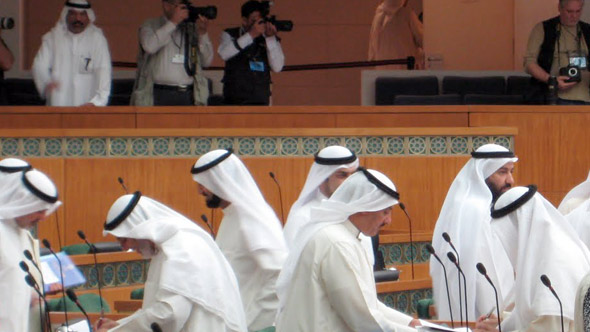
Ongoing rows between the government and parliamentary opposition parties triggers doubts among many Kuwaiti citizens about whether democracy and elections add value to the country.
On February 26, 2011, when Kuwaitis celebrated the 20th anniversary of their liberation from Iraq, happiness over Saddam Hussein's disappearance was overshadowed by mixed feelings over an uncertain future.
In order to tame sporadic protests that occurred in the wake of the Arab Spring in 2011, the ruling Al-Sabah-family reacted swiftly. On January 18 2011 Kuwait's Emir Sabah Al-Ahmad Al-Jaber Al-Sabah, distributed to every Kuwaiti citizen 1,000 Kuwaiti dinars (3580 U. S. dollars), and also granted free basic food ingredients like bread, drinking water or wheat to each national for one year.
Officially these donations were meant to commemorate the 20th anniversary of Kuwait's liberation from occupying Iraqi forces during the Second Gulf War and the 50th anniversary of the state's independence. But everybody knew that while Tunisia and Egypt slipped into a quagmire of turmoil and revolutions, these gifts were the Sabah's life insurance.
Within the Gulf Cooperation Council (GCC), only Kuwait, Qatar, and the United Arab Emirates (UAE), have managed to avoid civil unrest or demonstrations. These three states and the two kingdoms Bahrain and Saudi Arabi, along with Oman are also GCC members.
|
Kuwait's religious opposition groups used the spirit of the Arab turmoil in order to increase pressure on the government. They received support from street demonstrations and blamed the regime of high-level corruption.
|
Nevertheless, Kuwait's religious opposition groups, mostly Sunni religious conservatives, sowed the spirit of the Arab turmoil in order to increase pressure on the government. They received support, from street demonstrations and blamed the regime of high-level corruption. But public outrage never reached the dynamics of the Jasmin revolt in Tunisia or the Egyptian Tahrir Square unrest. While Bahrain's King faced opposition from the majority Shia population, the Kuwaiti Shia have traditionally supported Sunni Al-Sabah family rule. During Saddam Hussein’s invasion in Kuwait on August 2 1990, Shia military personnel within the Kuwait fought bravely against the Iraqi army, which, however, within six hours of fighting outnumbered and overwhelmed the Kuwaiti resistance.
In November, just before former Prime Minister Sheikh Nasser Al-Sabah was to be questioned on alleged payment of bribes to pro-government MPs, the Kuwaiti cabinet resigned.
Amid growing pressure from the parliamentary opposition and the street, the Emir Sheikh Al-Sabah dissolved the National Assembly, known as Majlis al-Umma, on December 7 2011, three weeks after the opposition moved for legislation asking Prime Minister Sheikh Nasser Al-Sabah to resign. Sheikh Sabah said "deteriorating conditions had led to difficulties in achieving progress and threatened the country's higher interests."
"Snap elections" were consequently held on February 3, 2012. Opposition candidates won 34 of the 50 seats in the Majlis, 23 of whom were Sunni Islamists. No female candidates, including the four incumbent of the prior assembly, made it to the chamber this time.
Observers expect that the stronger opposition will make it harder for the government to extend their traditionally close ties with Western powers and the U. S. in particular.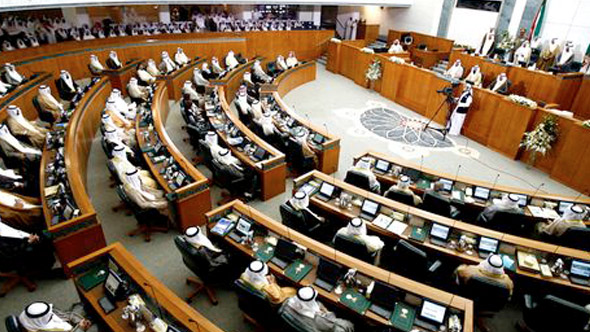
Despite all challenges, the Sabah dynasty has never been in danger of being toppled. Robust oil prices in 2011/2012 helped the ruling family to keep public frustration controllable—an advantage that neither Tunisia nor Egypt had. Kuwait's national budget relies 95 percent on oil export revenues.
But there is a flip-side of the coin. The rise in energy prices is mostly driven by tensions between the West and Iran. Western powers and Israel blame Tehran for developing nuclear weapons under the disguise of its civil nuclear energy program. Iran denies playing a double game and has frequently threatened to close the Straits of Hormuz. Such a move would badly hit the Kuwaiti oil industry, whose tankers are dependent on an open Arabian Gulf Isthmus.
Nevertheless, the northern Gulf state has proved that it has experience with crises. The Arab Spring shook the oil-rich state, but its constitutional system shows flexibility, and the government is able to move ahead because of strong oil revenues.
Kuwaitis still receive free medical care, free bread and water, and free telephone service within the country. As the Financial Times writes: "While other Gulf thrones may totter, Kuwait's has lasted for 259 years."