
Lebanon Information
Lebanon is a not quite tiny, but definitely a small country nestled along the eastern coast of the Mediterranean. About the same size as Jamaica, and ten percent less than Qatar, its total area of 10,400 km2 ranks it 166th on size out of 223 of the countries of the world.
Overview
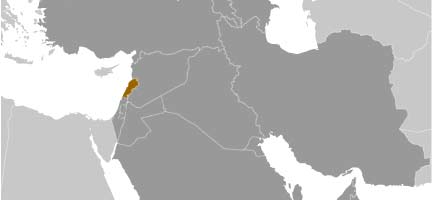
Lebanon is a not quite tiny, but definitely small country nestled along the eastern coast of the Mediterranean. About the same size as Jamaica, and ten percent less than Qatar, its total area of 10,400 km2 ranks it 166th on size out of 223 of the countries of the world. With a population of 4.2 million, and a density of 404/km2, it ranks 24th in population density, about the same as the Netherlands (400/km2) and slightly higher than Israel (365/km2). Sandwiched between Syria on its northern and eastern borders and Israel on the South, its western border consists of 224 km of beautiful beaches along the Mediterranean.
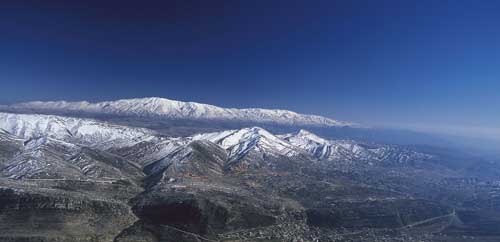
Geographically, Lebanon consists of a coastline, and two mountain ranges separated by a valley, running lengthwise roughly North-South, and all contained within its eastern and western boundaries which are no more than 88 km apart at their widest and 32 km at their narrowest. What this means is that, from the outskirts of its capital, Beirut, almost no part of the country is less than 110 km (66 miles) away.
Before 1975, Lebanon was the economic hub of the Middle East, which included being its banking, commercial, merchandizing, media, social, cultural, and diplomatic center is well. By the end of the civil war, many other countries (e.g., UAE, Qatar) were vying to become the Mideast center for one or more of these functions, and many now succeeded. Since the end of the civil war (1990), however, and especially since the end of the turmoil of 2005-08, Lebanon is back in the running to regain its role, if not of preeminence, at least to becoming one of the Mideast’s brightest centers.
No one can understand Lebanon without understanding its history. Here is a brief introduction, concentrating most on the important recent events:
Economy Overview
Evidence of civilization in Lebanon dates back more than 7,000 years. For roughly 2,500 years it was the home of the Phoenicians (cir. 3,000 to 2,500 B.C.E.), a sea-faring people who traded throughout the Mediterranean area. It was conquered and came under the domination of a succession of expansionist powers: notably Persia, Assyria, Hellenistic kingdoms, Roman, Eastern Roman, Arab, Seljuk, Mamluk, Crusader, and the Ottoman Empire, and finally under French colonial rule. Throughout each of these it grew as a trusted banking center, with corresponding gains in trade and wealth. Its capital, Beirut, one of the most charming of all Middle Eastern capitals, became known as the “Paris of the Orient,” and the country in general was referred to as the “Jewel of the Middle East.”
Today, Lebanon is still dominated by its banking sector, which comprises 35 percent of the economy. Lebanese banking is a home-grown industry, by which is meant that it is largely dominated by old families with a deep treasure chest of banking experience that guides them through both good times and bad. Studying the banking system with an experienced eye, Lebanon’s Central Bank as early as 2005 noted the presence of dangerous securities in the financial markets, and quickly prohibited them. As a consequence, Lebanese banks came through the 2008 global financial crisis not only without losses, but with vastly increased deposits as depositors searched for banking systems whose judgment the respected.
In 2008, the first year of the Doha Agreement that signaled the end of internal violence, the economy grew by 8.5%, 9% in the following year, and is on course to grow 7% in 2010. The important thing to keep in mind is that this growth is the result, simply, of peace and independence—the cessation of internal and external violence and foreign meddling. On these two issues, the voters are in overwhelming agreement, and all the parties and factions are pledged to maintain it.
Government Overview:
Chief of state: President Michel SULAYMAN (since 25 May 2008)
head of government: Prime Minister Sa’ad al-Din al-HARIRI (since 9 November 2009); Deputy Prime Minister Elias MURR (since 9 November 2009)
cabinet: Cabinet chosen by the prime minister in consultation with the president and members of the National Assembly
elections: president elected by the National Assembly for a six-year term (may not serve consecutive terms); election last held on 25 May 2008 (next to be held in 2014); the prime minister and deputy prime minister appointed by the president in consultation with the National Assembly
election results: Michel SULAYMAN elected president; National Assembly vote – 118 for, 6 abstentions, 3 invalidated; 1 seat unfilled due to death of incumbent