
Morocco Real Estate Sector: Social Housing is the Key
Morocco Sector Analysis
Morocco Real Estate, Construction, and Housing
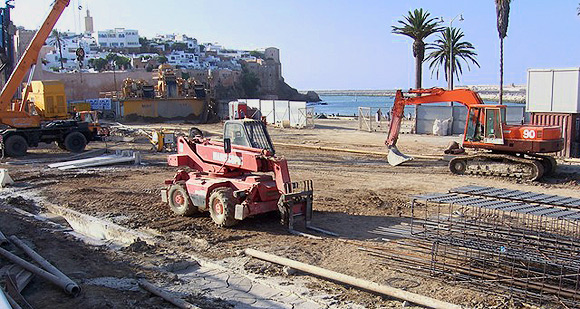
Ever since Morocco put in place its “Vision 2010” plan of national development in 2001, the real estate, construction, and housing market has been one of the most dynamic and growing sectors of the economy, constituting about 6% of GDP.
Morocco Real Estate, Construction, and Housing
> Morocco Luxury Real Estate
> Morocco Social Real Estate
> Group Jamai -Leader in Morocco Real Estate and Construction
Ever since Morocco put in place its “Vision 2010” plan of national development in 2001, the real estate, construction, and housing market has been one  of the most dynamic and growing sectors of the economy, constituting about 6% of GDP.
Morocco has been exceptionally successful at attracting foreign investment capital. This is primarily—but not exclusively—due to the growth of the tourist sector, where the greatest national planning and effort has been to build tourism as the dominant source of the country’s foreign exchange earnings, as well as a source of significant job growth.
Ever since Morocco put in place its “Vision 2010” plan of national development in 2001, the real estate, construction, and housing market has been one of the most dynamic and growing sectors of the economy, constituting about 6% of GDP.
As a result, Morocco real-estate and especially, the housing market in Morocco may be best considered in terms of two main sectors: high-income luxury housing, and lower-income social housing, which are two entirely different markets. High-income luxury housing is clearly linked to the international market, while low-income social housing is driven by local demand.
Morocco Real Estate Luxury Housing
The purpose of Morocco’s drive to increase tourism is not merely bring short term visitors to Morocco, but also to attract long term residents who desire to purchase and own their own properties in Morocco real-estate sector, such as retirees and successful professionals and entrepreneurs who can afford vacation homes. Thus Morocco initially planned 6 new resort cities in coastal regions, and has since added several other planned new cities throughout the country.
Of course, it is expected that this housing shall also attract middle and upper class Moroccans. Similarly, there are a multitude of luxury housing developments both in and around Morocco’s major cities and other tourist destinations. So far, these had little difficulty attracting both indigenous and major foreign investors.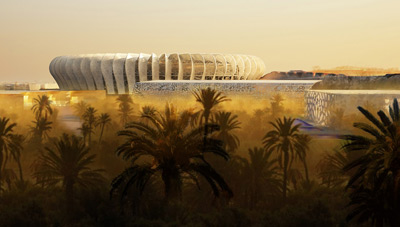
Morocco Real Estate and Social Housing
The social housing market in Morocco is driven by three main factors: demographics, migration from rural to urban, and rising GDP.
Demographics. The central fact of Morocco today is the huge population bulge that has occurred in the last two decades, resulting in a 50% increase in population; from approximately 24m. in 1990, to almost 36m. in 2010, resulting in one-third of the country under 21 years of age. According to the CIA Factbook, the median age of the population is 26.9 years.
Rural to Urban Migration. While the agriculture sector is sill Morocco’s largest employer, it cannot absorb the huge numbers of young who are now coming of age. As a result, according to Ahmed Taufiq, Housing Minister, “Each year, Moroccan cities receive 60,000 new inhabitants which entails the construction of 150,000 new houses over an are area of 500 hectares.”
Rising GDP. While Morocco has had one of the lowest GDP-PPP since independence in 1956, its wealth has been rising since 2001, when it began its drive to attract FDI and expand both its tourism, industrial, and agricultural export sectors. As a result, the government has, since the mid-1990s, led major efforts to replace the slum areas around cities with decent housing, and raise both educational level and standard of living of its citizenry in order to staff its new tourism facilities and its new industries.
Because of these three factors, an “estimated 70% of market demand is for social housing,” says Youssef Ben Mansour, Chairman of the National Federation of Housing Developers.
According to Abdallah J. Slaoui, Chairman of Jascom, 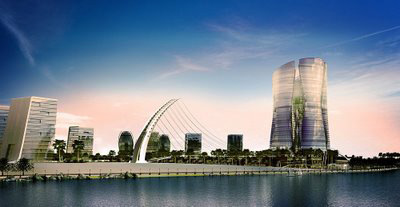
“there is currently a deficit of about on million units, along with an annual increase of 100,000 units. Today, Morocco builds 150,000—at best, 200,000—units per year. We’re just covering the annual increase, and barely” denting the total deficit.
One of Morocco’s efforts to combat the problem is its “Cities without Slums” program, for which over US$3 bil. has been set aside to improve the condition of existing homes. More than 138,000 people have thus been benefited with better housing.
In 2010, the government announced major programs to increase social housing and stimulate Morocco real-estate. These included significant tax breaks for developers, guarantees to spur banks to grant mortgages, subsidies for both developers and buyers to bring down the cost of housing, and the making available of 3,853 hectares of public land for social housing. The present goal is to build, market, and finance the purchase of at least 200,000 units per year.
Group Jamai – Leader in Morocco Real Estate and Construction
One of the oldest and largest operators in Morocco real estate sector is Group Jamai, which is family business formed by five brothers and their cousins who bring together a combination of competences in three major sectors of the economy: textiles, agriculture, and real estate development.
Ismail Jamai tells of the evolution of the group. 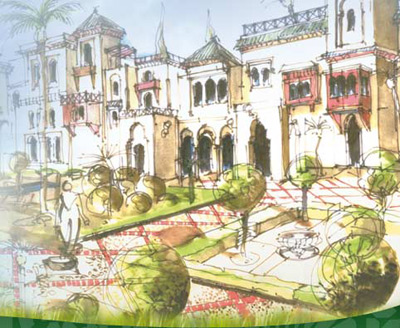
“Our company started with my father who was installed in Fez. He had a small textile factory, and … and went to France searching for different customers…to buy better products, bigger quality products. Having searched for customers in a very difficult way, having created this whole textile project that we are in now, it is very important because of the different steps that our group has gone through. We started with textiles. Agriculture is ingrained in our family, so we are all into agriculture. Agriculture is Morocco, Morocco is agriculture; it’s very important. And the reason why we do this is… because we are filling basic needs—we concentrate on what people need in their everyday lives: People have to eat, people have to wear clothes, and people have to live in a home; and I think this is the main reason why we are in these three sectors.”
Although Group Jamai entered real estate construction as early as 1968, when it was considered a pioneer in the field. It began its current involvement social housing in 1996 when it answered the call of King Hassan II’s National Initiative for Human Development to address the nation’s housing shortage.
Since then, Group Jamai has constructed 50,000 units. As a result, it claims to be “recognized within the Kingdom of Morocco for the patriotic sense of its shareholders, and participates actively in the promotion of habitats as an example and model of corporate citizenship.”
The idea of corporate citizenship is crucial to the identity and purpose of Group Jamai. According to the Group’s chairman, Ahmed Jamai, corporate citizenship means that not only is the housing planned and built, but also that all the other amenities of a functioning community are also incorporated in the planning and construction.
These include “educational institutions, from primary to secondary, health facilities—hospitals and clinics—mosques, and sports fields.” In other words, says Ahmed Jamai, “Group Jamai has always incorporated from the outset the parameters of ecology, social enterprise, green spaces, educational, health, sports, and culture in all its projects.”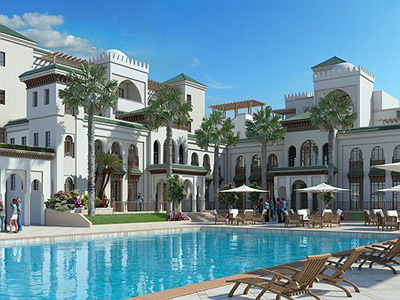
Ahmed’s son, Ismail Jamai, vice president of Group Jamai, has a more informal way of expressing the firm’s philosophy:
“I think it is very important for every human being living in our residence to have a smile. I always like to say…we don’t sell you four walls – yes, we do sell you four walls, but with a big smile inside. It is very important for you once you’re living in a house and you want to have a coffee, you’ll have a coffee shop close to you. Or you want to go for having a football match, you’ll have the sports facility next to you. When you want to go pray, you will have your mosque next to you. I think it’s very important for every single customer of ours to have a big smile on his face when he comes into his respective apartment, villa, or whatever he has bought from us.”
Ismail Jamai sees a bright future for real estate and construction in Morocco. Group Jamai is involved in both luxury housing as well as social housing. Of the two, Jamai sees social housing as the driver of the real estate sector for 2011 and beyond: Luxury marketing, he says, “has its future, it has its customers, but I think social housing is a market that is much more demanding.”
The reason for Jamai’s optimism is two-fold: First, the recent changes in laws and the new convention introduced between the government ministries and developers results in a “win-win situation where the constructor/real estate developer has his success and the ministry is happy because it is giving homes to the people, which is the goal of the country.” Jamai’s second reason is the change in the attitudes of the banks.: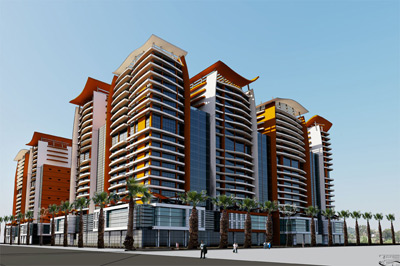
“In Europe, banks have been opening their doors for the last…20-30 years; here in Morocco, banks have just opened their doors; the interest rates have gone down, there is now competition between banks. I think this gives an opportunity for Moroccans to have a home. I think it’s very important that banks open their doors, because it’s the only way that people could have a home.”
Morocco Luxury Real Estate and Luxury Housing
Since its inception, Group Jamai has been involved with both luxury housing and social housing, and many projects that mix both types of housing. Among its luxury and mixed housing developments are Anassi, its first major project, Tamesna, and Tamanscourt. Since then it has built major projects in Fez (Joy City I and II), Meknes (Riads Al Ysmailya), Casablanca, Marakech, Rabat, Tangiers (Riad Sophia), and Agadir. One of its major projects presently is Martile et Tetouan along the Mediterranean coast—“along the best coastal area in Morocco.”