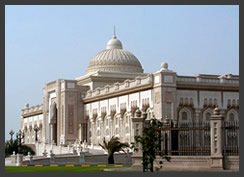
Sharjah the culture center of UAE Sharjah culture
“Sharjah was chosen by UNESCO in 1998 as the cultural capital of the Arab world”, underlines Mohammed Ali Al Noman, Director General of Sharjah Commerce and Tourism Development Authority, with pride in his voice.T hanks to several initiatives taken by Shrajah’s ruler, His Highness Dr. Sultan Bin Mohmmed Al Qassimi, Sharjah cannot be ignored by friends of Arab literature and Islamic art. “We feel like we are the museum of the world”, says Mr. Al Numan. HH Dr. Sheikh Sultan is a poet himself, he regularly writes and publishes stories of Arabian history and fairy tales for children. His books are presented every year at the famous Sharjah International Book Fair, which usually takes place in autumn in the Expo Centre-Sharjah.
|
As a prominent and close neighbour of Dubai, Sharjah is keen on offering travellers and tourists a different world. The emirate is famous for its religious and traditional values, which are embedded in cultural hot spots. This is why Sharjah is also called the epicentre of culture in the Middle East. |
|
| Capital of culture | |
|
|
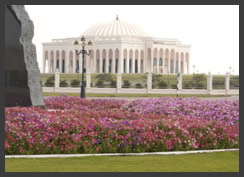
“Sharjah was chosen by UNESCO in 1998 as the cultural capital of the Arab world”, underlines Mohammed Ali Al Noman, Director General of Sharjah Commerce and Tourism Development Authority, with pride in his voice. Thanks to several initiatives taken by Shrajah’s ruler, His Highness Dr. Sultan Bin Mohmmed Al Qassimi, Sharjah cannot be ignored by friends of Arab literature and Islamic art. “We feel like we are the museum of the world”, says Mr. Al Numan. HH Dr. Sheikh Sultan is a poet himself, he regularly writes and publishes stories of Arabian history and fairy tales for children. His books are presented every year at the famous Sharjah International Book Fair, which usually takes place in autumn in the Expo Centre-Sharjah. The exhibition centre also hosts an Islamic fair during the Holy month of Ramadan. “Because in Sharjah we are trying to keep our city Islamic and more traditional, we have a lot of museums and aquariums for example which keep this feel”, Sulta Al-Mualla explains, who is Vice Director General at Sharjah Municipality. “We are joining culture and modernity in this city.” For a cultural holiday, the choice of sightseeing locations could not be more numerous. Take the heritage museum in the centre of the city, which overlooks the Persian Gulf, swords, arrows, golden jewelry, cooking items and ancient paintings of the special way of Arabic writing, called Islamic calligraphy, are items that date back to more than 3’000 years ago. |
|
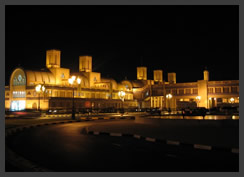
The two major souks are created to reflect Islamic designs. “Sharjah is well known to be a dry state. Having said that, it has nice entertainment developed for families”, says Mohammed Ali Al Noman, referring to the fact that alcohol is prohibited in the emirate, contrary to Dubai and Abu Dhabi’s relatively liberal environment. |
|
| Progress at all fronts | |
|
|
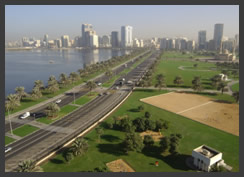
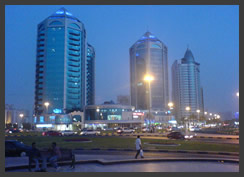
Tourist figures are picking up. Mohammed Ali Al Noman: “In 2000, we had 600,000 guests staying at Sharjah hotels and last year we reached 1.5 million so that says a lot. We had 20 properties back then and we have 90 properties today.” Such progress is attracting prominent brands in the hospitality sector: “We are happy to say that the Marriott will open a resort in the next couple of years, in 2010. We also have Sheraton, Novotel and Rotana, just to mention a few.” However, a drive through the city shows the sensitivity of a booming city. Because of cheaper accommodation, many people from Dubai moved to Sharjah, causing a daily rush hour in the morning and huge traffic problems. But Sharjah also offers well-paid jobs, notably in the pharmaceutical and trade industries. As an educational centre, Sharjah is famous for the University of Sharjah and the American University of Sharjah. Both schools offer modern subjects, such as IT or Islamic Finance and are most popular among women |
|
In order to solve the problem of traffic congestion, Sharjah is building several new highways, bridges and interchanges, new buses have been ordered and a study to connect Sharjah to the Dubai Metro (ready in 2009) is under way. |
|
| Air Arabia – the first low-cost carrier in the Middle East | |
|
|
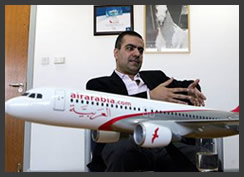
It was in 2004 that Sharjah became home to the first low-cost carrier in the region. When Air Arabia was launched, competitors in the GCC countries (UAE, Saudi Arabia, Kuwait, Qatar, Bahrain and Oman) raised their eyebrows and claimed that the low-cost model is a European model which will never work in the rich Gulf region. The critics disappeared when Adel Abduallah Ali, founder and CEO of Air Arabia (“Pay less. Fly More”) welcomed the one millionth passenger in 2005 aboard. Kuwait followed with Jazeera Airways in 2007. |
|
In Saudi Arabia, three budget carriers started operating. Air Arabia led to the expansion of Sharjah International Airport and to a huge success for the tiny cultural emirate, which will be remembered as another peaceful victory by HH Dr. Sheikh Sultan who supported the idea of a low cost carrier from the very beginning. Sultan Al-Mualla: “As the Sharjah Municipality we are in full cooperation with the economic department to make things work in Sharjah, by working with them to get the services to the people of Sharjah and for possible investors to find it easy to come here.” |
|