
Textiles in Morocco: Moroccan Special Advantage
Morocco Sector Analysis
Morocco Industry: Textiles Leading the Industry
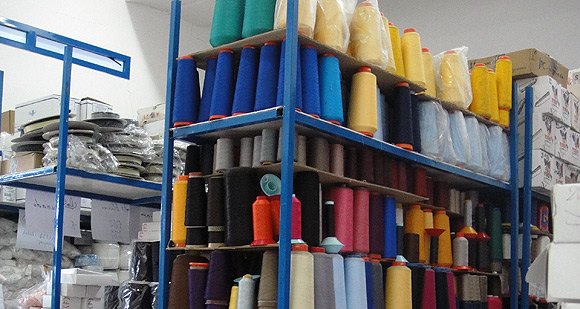
The textile industry, though relatively new in its current incarnation, is one of the most important segments of the Moroccan economy. In 2010, the export turnover in textiles totaled 28.3 billion, and grew at a rate of 5% over the previous year. With 200,000 employees, the textiles also constitute a significant part of the labor force.
Morocco Industry: Textiles Leading the Industry
Industry in Morocco represents roughly 24% of the GDP and employs 3 million people. The Most important industrial sectors include infrastructure development, mining, chemicals, construction materials, electronics, pharmaceuticals and textiles. Morocco industrial segment should contine to register growth, boosted by expanding manufacturing activities. The Tanger-Med port will raise Morocco’s profile as an attractive place for manufacturing.
The textile industry, though relatively new in its current incarnation, is one of the most important segments of the Moroccan economy. In 2010, the export turnover in textiles totaled 28.3 billion, and grew at a rate of 5% over the previous year. With 200,000 employees, the textiles also constitute a significant part of the labor force.
The textile industry, though relatively new in its current incarnation, is one of the most important segments of the Moroccan economy. In 2010, the export turnover in textiles totaled 28.3 billion, and grew at a rate of 5% over the previous year. With 200,000 employees, the textiles also constitute a significant part of the labor force.
The present status of the textile industry is barely two decades old in Morocco, for it was about twenty years ago that textile firms in Europe began to face problems of cost and wages, forcing many to relocate to Morocco for lower costs, and allowing many small firms in Morocco to form or grow. Michelle Duperrin, president of Rectangle s.a.r.l., explains the history that established much of the present textiles industry in Morocco:
“The textile sector relocated from Western Europe more than twenty years ago. On one hand, the [European companies moved] to all those countries close to Western Europe (Tunisia, Morocco, Turkey, and Eastern Europe) where the local workforce is much more affordable than [Western] Europe’s. On the other hand, [many moved] to Asia where both end products and manpower were available. The Asian countries’ production costs were at one time more attractive than ours. However, several other issues, such as the rising cost of fuel, natural gas, and transportation, great distances and delays have had a direct impact on costs. So, the companies returned to nearby countries like ours.”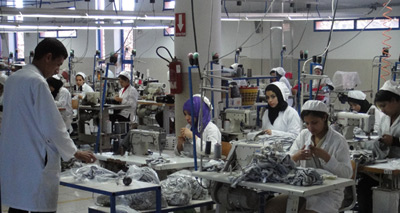
The Moroccan textile industry still faces significant challenges from Asia, notably from China , India, and Pakistan, but nevertheless is confident that it can maintain its position in the European market and continue to grow. A brief summary listing of its main competitive advantages is as follows:
-
Proximity to European markets;
-
Ability to meet shipping and delivery deadlines punctually;
-
Development of experience and professionalism over the past two decades;
-
Market knowledge and a mastery of European standards;
-
Competitive advantage in transportation costs, pricing, and service.
In addition to these purely economic cost, delivery, quality, and service advantages, the Moroccan textile industry has three more general advantages:
-
In Morocco, the state provides platforms, coordination, and funding for the international marketing of Morocco’s textile products and capabilities; in other words, no Moroccan textile manufacturer faces the market alone;
-
Morocco has a simplified and integrated logistics systems that remove the logistics problems guarantee delivery of products on time; and allow the manufacturer to concentrate on manufacturing; and
-
Morocco is politically, economically, and socially stable. This is an important factor to European fashion houses and retailers who do not want to worry about political or social disruption of their foreign suppliers.
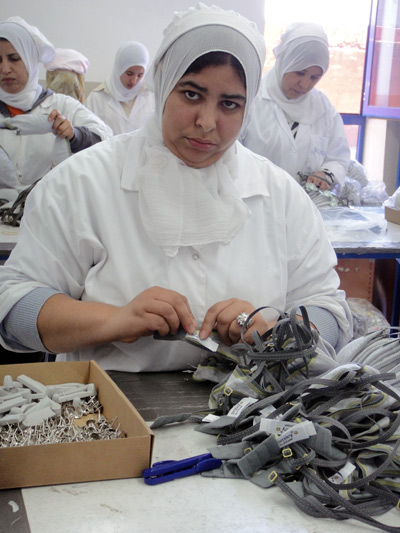
As a result of this history, Duperrin believes that there is a good future for the textile industry in Morocco, “because I don’t believe that Europe can resurrect its own industry, since the price of manpower on its territory does not allow it anymore.” Duperrin adds: “The only possibility for Europe is to trust countries like ours…. I think Europe needs Morocco, Tunisia and nearby countries. We are slowly becoming the suburbs of Europe.”
The close relationship that Moroccan textile companies can form with European wholesalers, fashion houses, and retailers is based on many factors that give competitive advantage. Duperrin discusses a few of these experienced by her own company, Rectangle:
We are already working with many other companies, including Etam and Princess Tamtam, two companies specializing in lingerie. A new customer will always check with which companies we work to evaluate our skill level. Many companies already work with us and trust us: it proves that we have a great expertise. In addition, we make efforts to create partnerships with France’s governmental institutions and professional orders to meet the investors’ needs.
As a result of all these advantages, the field of “textiles-clothing, though composed largely of small and medium enterprises, has come to occupy a strategic position in the Moroccan economy, both in terms of jobs and exports, but also in terms of community and sociological development.
According to Duperrin, the greatest problem faced by the industry is not from competition from other countries, but the difficulty of finding sufficient numbers of adequately trained and skilled employees: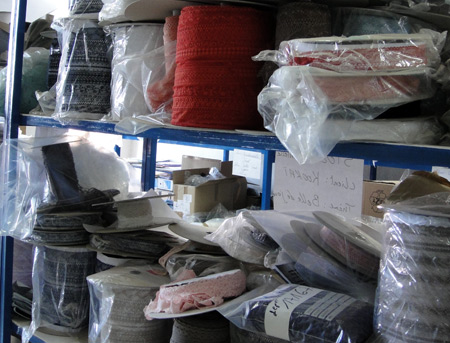
“The biggest problem we face is the staff shortage. That’s what is keeping us from moving forward. If we want to develop the sector we will need to train new workers again and again. I think it’s a national problem and that Casablanca and Tangier are also suffering from this shortage of manpower. There are about 20,000 vacancies in the textile industry and in a country where there are so many unemployed workers it is unfortunate that there is no balance between supply and demand.”
Recently, the Moroccan Office of Vocational Training entered into an agreement with the Moroccan Association of Textiles and Clothing (AMITH) to train and educate 20,000 youth to fill openings.
Nevertheless, despite the training and staffing problems, Duperrin is confident about the future and the growth of Moroccan textile markets.
“I think the textile sector is set to expand in Morocco so we have to grow in order to be ready to meet the European enterprises’ requests. A small business like ours saturates at 100,000 pieces per month and we feel that some French and Spanish companies might soon request larger orders. So, if we want to be sure that they will do business here in Morocco, we must be prepared to meet their standards.”
Group Jamai
Group Jamai is one of the oldest and most successful family firms in the textile sector. Beginning as a small factory in Fez, it grew by its pioneering work to establish marketing in France. The Grand Pere of the family, Ahmed Jamai, simply went to France knocking on the doors of fashion houses and retailers, where he learned the secrets of success that have guided Group Jamai ever since: namely, find out what the customer wants, produce it with perfect quality, and deliver it when the customer wants it.
Although facing recent competitive challenges from Asia—e.g., China and Vietnam—and even from countries closer to home in the MENA Region, namely Turkey, Ismail Jamai, vice president of Group Jamai remains bullish. “We try to produce a better product, trying to reach perfection,” says Jamai. But the real key is time: “we need to deliver the product in a small period of time.”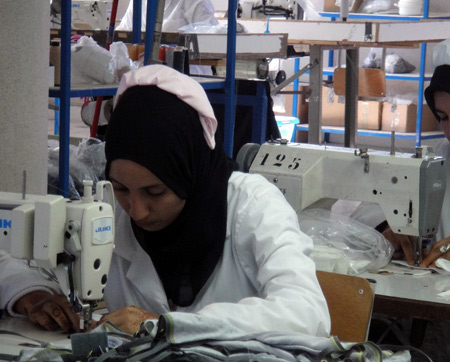
To meet the time demands of customers, two factors are critical to success, says Jamai. First, the manufacturer must coordinate all the steps of production within a single entity.
“If you try to do all the steps of textile production from raw material to final product through contracting out to others, it is very difficult to manage. Having one entity do all the different steps is important.” Group Jamai Textiles has expanded to encompass all the steps of the production under one corporate roof, guaranteeing both quality control and speed.
The second factor allowing Jamai to compete against competition form other countries in Asia or the Middle East is location. Morocco’s location just fourteen miles across the straits of Gibralter allows Jamai to deliver to Paris, if necessary, within 24 hours of production.
But, of course, the time period is usually longer, to embrace production time. Thus, if a shop in France or Belgium sends an order for a certain design, says Jamai, “I will produce and deliver it in two weeks. If a shop needs a stock of 3,000, I will deliver them; if a shop needs 5,000, I will deliver them.” In sum, “The positioning of Morocco helps one face the challenges of textiles; we are close to our market in Europe.”
Crucial, too, to Group Jamai’s success, is its management style. Ismail Jamai recounts that when he was an eight year-old boy, he use to come in with his father to the factory, where he would learn from his father how to meet and get to know all the employees.
“During my weekends, I didn’t used to go to the movies, I used to, instead go with my father to the textile industry, meeting with people working on the different kinds of machines, meeting other different guardians who are there, going to eat with these people, maybe having lunch with them from time to time.” That is when he learned from his father that, “It’s very important to be able to speak between all my engineers in the same way as I talk to others at the same level as myself.” As a result, at Group Jamai, “everyone feels confident that he’s working for an employer that is kind of like a very close friend or a family relationship.”
The Family Jamai also has a large sense of corporate responsibility to the community. Thus it has created the Jamai Association of Social Work, whose activities include: “building hospitals, treating the sick, treating the blind, treating the dead; these are things that we do in our everyday lives.” Ismail Jamai’s mother is in charge of this Association, though “in the morning she works in the textiles, and in the afternoon, she goes treats the kids.” Of her, Jamai says,
” She’s also the president of Cancer Association in Casablanca and in it we have built some two or three hospitals, giving those people that sometimes are in the last days of their lives, sometimes it’s the place where they probably heal themselves. I think it is very important to have this social life part; every single business man needs to have this, needs to have a heart for the people who we see every day.”
Just as the Jamai family is close to each other and their employees, Ismail Jamai feels a special loyalty and affection for the environs of Meknes, about which he waxes eloquent:
“I mentioned Meknes; I always would like to come back to Meknes, because my success as the Vice President comes back to Meknes which is the city that is really in my heart. I think the geographical position of Meknes is amazing because you’re 15 minutes from snow, you are maybe 45 minutes away from the beach. You are in a city where in every direction you’re next to the countryside, you’re next to greenery. I think that Meknes is a city that will always stay in my heart, it’s there where I made my first success where I have proven myself, so I really want to give a big thanks to that city for having given me this opportunity and I would like to thank the authorities in Meknes for having helped me, for having guided me, and for having always treated like one of their sons respectively. I would say the mayor, the wali, the governor for having helped me and making me succeed because every little help in a company like that, every person who encourages you in your everyday life helps you try to succeed and try to give more of yourself.”