
Cultural Bahrain – A Soft Introduction to Arabia
Business-friendly Bahrain is the centre of the Gulf and not the centre of attention, as Bahrain claims in its newly launched ad campaign. Nevertheless, the “Island of 1,000 smiles” also has its cultural flair with its capital city Manama hosting numerous mosques, museums, galleries, and monuments. Bahrain has places to fulfill every desire for fans of culture, arts, music, and tales of One Thousand and One nights.
The pictures on the first pages are mainly maps and skyscrapers, but also contain a few typical oriental images of mosques and fortresses. A common mis-impression about the Middle East is that, in order to discover culture of One Thousand and One Nights, you have to go to Egypt, Jordan or Syria; while for business you have to book a plane to the oil-rich gulf monarchies. But Bahrain travelers know better.
While those countries offer a strong introduction to the Orient, Bahrain offers a soft introduction to Arabia. The tiny Kingdom is ideal for weekend-tourism. Over breakfast in one of the Hotels in Manama, tourists can simply plan a two- day trip in the country over a nice cup of Arabic coffee.
An island’s guide to cultural heritage
Business-friendly Bahrain is the centre of the Gulf and not the centre of attention, as the Kingdom claims in its newly launched ad campaign. Nevertheless, the “Island of 1,000 smiles” also has its cultural flair with its capital city Manama hosting numerous mosques, museums, galleries, and monuments. Bahrain has places to fulfill every desire for fans of arts, music, and tales of One Thousand and One nights.
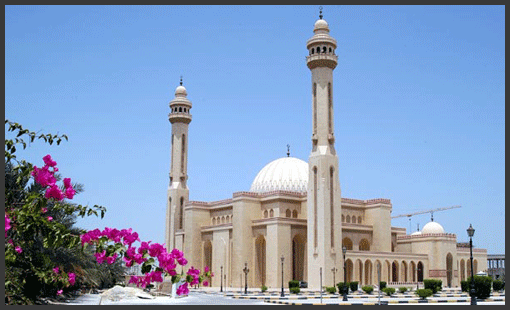
In the centre of a round tour is the old fort on the north coast, which was inaugurated in February 2008. The adjacent Bahrain Fort Museum is located on a site that was archaeologically examined in 1954 by the Danish mission. Their studies revealed that many different civilizations had sequenced the area, such as the Babylonians, Assyrians, and Persians. The island was eventually conquered by the Arabs in 630 AD and the early traces of Islam on display in the museum include Islamic calligraphy and paintings of the Holy Caaba in Mecca.
 <“Since 2005 the ancient fort enjoys the status of a UNESCO World Heritage site”, says HH Sheikha Mai Bint Mohammed Al-Khalifa , the Minister of Culture and Information (opposite picture). There is no doubt: the old Bahrain fort is a must on the agenda of a cultural journey to the Kingdom.
The iconic Bahrain National Museum gives a tour d’horizon of the history of the country. HH Sheikha Mai: “Some ancient industries survived through millennia and are still present. A good example of such industries with a long tradition are the clay manufactures of Hali, which are 5,000 years old. Tourists have an opportunity to see them still working as they did 5,000 years ago.”
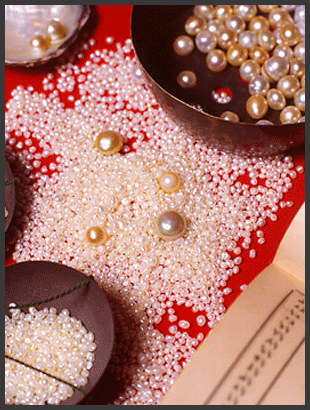
Before 1931 pearl diving was a major industry, and professional divers are still diving for them although a pearl heritage trail for tourists is not yet completed.
Nevertheless, Bahrain is eager to show still more of Arabian culture and Islamic history. “Bahrain has a very rich culture dating back to 5,000 BC”, explains HH Sheikha Mai. After the Arab conquest, Bahrain became a Portuguese colony in 1515. The Persians recaptured Bahrain during the 17th and 18th century until the Arab dynasty Al-Khalifa took over power in 1783 and has been ruling the country until today.
“We are also planning a second site museum at Saars settlement,” says HH Sheikha Mai, who recently restored several old houses near the El Ebrahim centre on Al Muharraq island.
A feast for the eyes
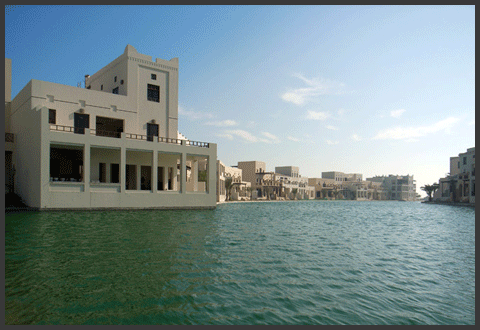
Another popular tourist site is the picturesque Water Gardens complex on Hawar and Amwaj Islands, including the Arabesque Art Gallery and colorful Art Gate Gallery.
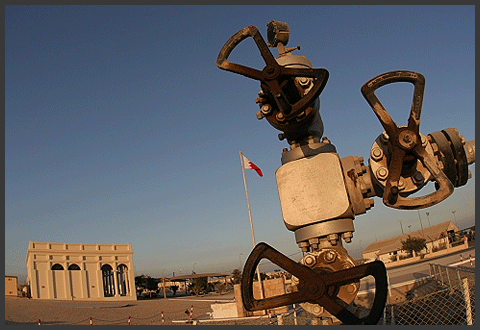
Bahrain was the first country on the Arab peninsula where oil was discovered. The Oil Museum in Manama takes visitors from the early years when the ‘black gold’ was first discovered, to today’s impressive technology.
Bahrain, however, is not a desert country with idyllic Bedouin life, such as in Saudi Arabia and the UAE. Nine tenths of Bahrain’s population live in cities. But the urban life and a population of around 1 million people, growing at a rate of 2.4 per cent p. a., is also an obstacle. HH Sheikha Mai: “In order to attract tourism, we have to be ready. Right now we are not ready and the infrastructure isn’t where we need it to be.” While Dubai is finishing the first metro on the Arab peninsula and has more than 1,000 modern Mercedes and MAN public busses on its roads, the common means of transport in Manama remain the cabs.
Dr. Heba Aziz ,Executive Director of the Tourism Promotion Project at the Ministry of Culture and Information (picture below) is optimistic about Bahrain’s future as a travel destination, despite a global decrease in tourism due to the recession. During spring, the island state hosts the Spring of Cultures Festival, and a new summer festival: “There is also a new festival for this year that will be called The Bahrain Summer Festival and again there will be cultural activities, workshops, and other things”, Dr. Aziz says with a smile as she would like to invite the world to come over to her country.
 With so many events in the pipeline, aren’t Dr. Aziz and her department afraid of less visitors due to the global economic crisis? “I think in 2009 we will retain 2-3 per cent growth comparable to 2008. And I highly doubt that we will encounter negative growth like we did in 2001”, she says. In 2008 around 6.5 million people visited Bahrain. The evenings and nights offer typical Arabian flair at grill parties with belly dancing and traditional Shisha pipes. Popular dishes are vegetarian falafel, couscous with mutton meat, and Lebanese salad.
At second glance, however, some pieces in the cultural jigsaw are still missing. “A national theatre is a must for Bahrain”, HH Sheikha Mai says with an audible sound of regret in her voice. “In the 30s or 20s there was a movement in Bahrain and it was a pity not to have a proper theatre. We started to build the theatre with French architecture and I hope by 2011 it will be ready.” Although Bahrain offers a wide range of heritage sites and galleries, the pieces of the cultural jigsaw of the country are still being set.
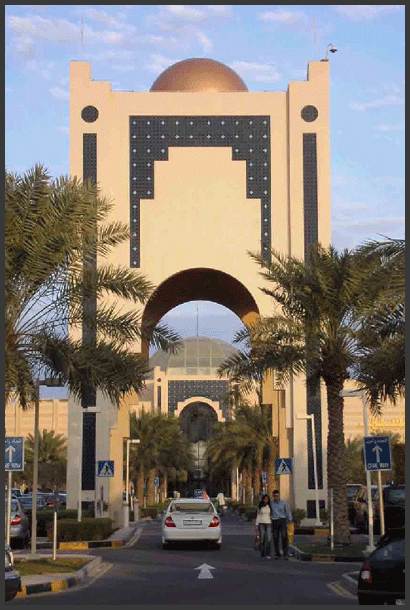
In terms of shopping, there are 18 big shopping malls in Bahrain, located all over the country. The most popular is the Al Seef shopping mall in the capital. These 18 malls have a gross leasiable area (GLA) of 280,000 square meters. That is the space which retailers, supermarkets and boutiques can effectively use in order to sell their products.
But Dubai’s biggest shopping centre, the Dubai Mall alone has a GLA of 350,000 sq m. In order to attract more shopping aficionados and consumer cowboys from the globe, Bahrain’s retail sector plans to add another 370,000 GLA.
For family pleasures, the following new projects are in the pipeline: a water park, two new luxury hotels and a cinema complex with 20 screens.
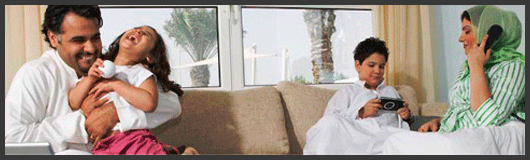
So how can one put travel and tourism in Bahrain in a nutshell? Dr. Aziz expresses her wishes: “I would love to see Bahrain as the boutique destination of the Gulf and as a small, beautiful destination comparable to Monaco or Monte Carlo”. Until 2016 travel and tourism are expected to contribute a quarter to the Bahrain’s GDP.