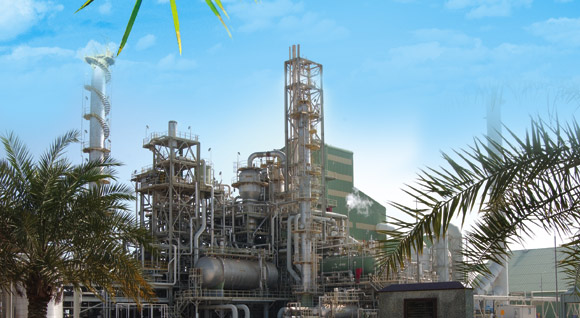
Gulf Petrochemical Industries: Fertilizer Production in Bahrain
Friday, 08 July 2011 07:45


Gulf Petrochemical Industries Company (GPIC)

Gulf Petrochemical Industries Company (GPIC)

The story of petrochemicals in Bahrain begins in December 1979 with a joint agreement entered into by three Gulf states—Bahrain, Kuwait, and Saudi Arabia—to cooperate in the manufacture of fertilizers and petrochemicals by utilizing Bahrain natural gas supplies.

quoteUrea


divider_hori

"The fertilizer industry plays a major role in the future of the planet"


divider_hori

Under the agreement, a new company, Gulf Petrochemical Industries Company (GPIC), was to be formed as a joint venture equally owned by the government of the Kingdom of Bahrain; Saudi Basic Industries Corporation (SABIC) representing Saudi Arabia; and Petrochemical Industries Company (PIC) representing Kuwait. GPIC's board of directors is composed of an equal number of directors chosen by these three owners.

A site was chosen on 60 acr es of reclaimed land on Sitra Island in Bahrain, on which two plants were to be built, one to produce ammonia, and a second to produce methanol. Aerial GPIC
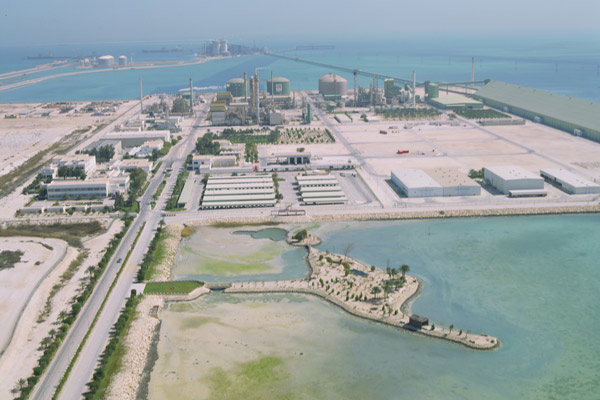


These two plants were completed and commissioned in May 1985, each with a capacity to produce 1,000 metric tons per day. In 1989, these plants were enlarged to produce 1,200 metric tons per day. In 1998, a third plant was completed to produce 1,700 metric tons of urea per day.

GPIC is one of eight major petrochemical producers in the Gulf Region, and although it is the smallest country in the Arabian Gulf region, it has continued to play a pioneering role.

GPIC specializes in three primary products: ammonia, methanol, and urea. Other petrochemical producers in the Gulf Region also produce petrochemicals for plastics, synthetic fibers, and various other industries. GPIC's main market focus for its products, particularly ammonia and granular urea, is tied to the food sector.

GPIC's Product Descriptions and Uses

Ammonia is one of the most common basic chemicals in the world and the primary compound for the production of nitrogenous fertilizer worldwide. It is primarily produced from natural gas. Ammonia is synthesised by the reaction, of hydrogen and nitrogen under high pressure in the presence of a catalyst in an Ammonia Converter.

Ammonia is used in the production of cattle feed, resins, fertilizers, explosives, textiles, refrigerants, rubber, metallurgy, drugs, photography, food/beverages, organic/inorganic, chemicals, leather, water treatment, pulp and paper, petroleum refining, aeronautical/space research, and detergents/wetting agents.

Methanol (or methyl alcohol) is also produced primarily from natural gas and involves the reaction of carbon monoxide, carbon dioxide and hydrogen over a catalyst. The consumption of carbon dioxide, a byproduct of ammonia production enhances the potential integration between these two types of plant. Methanol is used in the production of resins, polymers, plasticizers, solvents, octane improvers, fuel additives, corrosion inhibitors, methyl halides, cleaning, extraction, and antifreeze.Urea
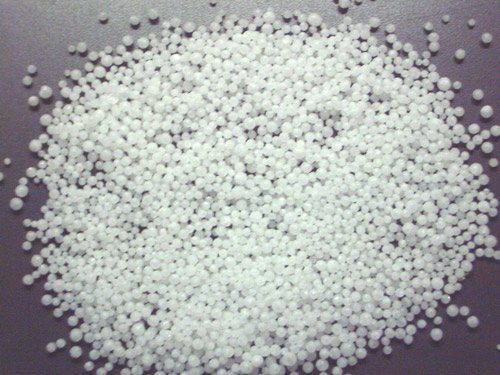
Urea is used in the production of fertilizers, cattle feed, and urea formaldehydes; and is the most widely employed nitrogenous fertilizer in the world, because it is a major requirement for the cultivation of rice, the staple food for more than 50% of the world's population. Urea is produced by reacting ammonia and carbon dioxide. The resultant solution is concentrated and granulated to form a free-flowing solid bulk product that can be stored, shipped and applied by end-users worldwide.

The International Economic and Social Importance of GPIC's Fertilizer Production

"The fertilizer industry plays a major role in the future of the planet," says Mr. A. Rahman A.Hussain Jawahery, President of Gulf Petrochemical Industries Company (GPIC). "Few people realize that the fertilizer industry is responsible for feeding up to 70% of the world's population. We produce, in nitrogenous fertilizer, over 125 million tons. These are used by farms in every corner of the world."Thus, Jawahery insists, "The fertilizer industry is really the backbone of sustainability of global population and of global economy."


[Back]

Comments  

-1 shaibu i etsumah
Thursday, 29 November 2012
i want be a distributor of you products to west Africa region.please tell me the procedure to getting into your distributorship .my mobile is 35407024 and my e mail is etsumahshaibu@y ahoo.com
Quote
0 bhaskara nand
Wednesday, 12 September 2012
i want co2 senior operator plant job with 16th year exprince in producation unit and maintance plz consider now working in bahrain
Quote
0 U.L. JATAV
Saturday, 08 September 2012
I want post of shift engineer or shift manager. I have degree of chemical engineering with 23 years experience in urea plant of national fertilizers ltd , India. My contact No. is 09425354391 and my email is . Please send me call when vacancies are available.
Quote
+2 MITESH TALATI
Sunday, 05 February 2012
i want to ammonia plant senior operator and presantly also working as same post in ksa .
Quote
-2 MITESH TALATI
Sunday, 05 February 2012
I want to ammonia plant job as senior operator and presantly also working as ammonia plant senior operator in ksa.
Quote
0 n n srivastava
Sunday, 29 January 2012
I want to join UREA plant as an PLANT OPERATOR. If any vaccancy exists currently then please inform me
Quote
-1 Admin
Thursday, 21 July 2011
Dear Banotu, you have to write to your respective manager to address this request.
Quote
+1 Hachya Banotu
Saturday, 16 July 2011
career vacancy in GPIC fertilizer plant ,bahrain
Quote
0 Hachya Banotu
Saturday, 16 July 2011
i want shift supervisor post or shift manager post if have any vacancy in urea plant
Quote
Banner


Top Interviews
Mona Almoayyed, Managing Director of Y. K. Almoayyed & Sons Women's rights in Bahrain: Steady Progress Towards Equality

Mona Almoayyed, Managing Director of Y. K. Almoayyed & Sons

Women and men in Bahrain are paid the same wages; there is no differentiation according to the labor law. On the other hand, for women there are lots of privileges. For example, for maternity with the new labor law it is 60 rather than 45 days.

Abdul Karim Ahmed Bucheery, Chief Executive of BBK Bahrain Banking in Bahrain: In-Depth Overview of Banking, Banks and the Market

Abdul Karim Ahmed Bucheery, Chief Executive of BBK Bahrain

Despite the crisis, banks are still sticking to Bahrain and if you think about the reason for this, Bahrain is situated almost exactly in the middle between the richest oil field in the world and the richest gas field in the world.

Bahrain: Inquiry into Media Freedom and Human Rights in an Exclusive Interview

Sameera Rajab, Minister of State for Information

The freedom of speech is 100% guaranteed through constitutional texts. The new media law includes more details and privileges for journalists and media personnel, it also provides more protection of this freedom.

Shaikh Mohamed bin Isa Al-Khalifa, CEO of Batelco Group Batelco Group: Expanding Operations to New Markets

Shaikh Mohamed bin Isa Al-Khalifa, CEO of Batelco Group

Batelco has always been at the forefront of innovation. The leading telecom company in the Middle East has always strived to provide its markets with the latest technology and the recent launch of the 4G network in Bahrain only confirms Batelco's superiority and efforts to offer its customers the best services available. The company was able to grow its subscriber base to 7.8 million in 2012 and its recent acquisition of Cable & Wireless was finalized only a few days ago. Thus, Batelco is progressively establishing itself as a communications player of global relevance and Bahrain's most diversified international company.

Fawzi Ahmed Kanoo, Deputy Chairman of Yusuf Bin Ahmed Kanoo Doing Business in Bahrain: Cautious Optimism About 2013-2014 Grows

Fawzi Ahmed Kanoo, Deputy Chairman of Yusuf Bin Ahmed Kanoo

Today, we have about 6,000 people working for us Gulf-wide and about 700 people in Bahrain. We have seen the first two months of the year as encouraging and even though in January business is normally down we have seen encouraging results. So I personally believe we are on the right track and that we will have a good year in 2013.

Dr. Hassan A. Fakhro, Bahrain Minister of Industry & Trade Bahrain Ministry of Industry: Economic & Industrial Development of Bahrain

Dr. Hassan A. Fakhro, Bahrain Minister of Industry & Trade

How much easier it is to be critical than correct (Disaeli). I would ask those who would criticize Bahrain, to look to their own countries

Bahrain National Oil and Gas Authority Outlines Future of Bahrain Oil and Gas Industry

National Oil and Gas Authority, HE Abdul Hussain bin Ali Mirza, Bahrain Minister of Oil and Gas

Today, the income from oil and gas constitutes about 80% of the government's revenue. However, we were also the first GCC country to attempt diversification, in the 1960s and 70s. Thanks to those efforts, oil and gas now only constitute 24% of GDP at current prices (and 12% at constant prices).